




2011-06-04, 10:44 AM
2147483647 Wrote:Wait.
∮1/z dz = ∫ [3/2 ie^(iθ- 1/2 ie^(-iθ
= i ∫ [3 e^(iθ
When you reached this step, how did you go to the next one? It seems like you somehow dropped the exp(-iθ
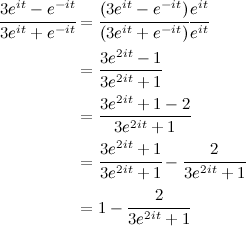
And it seems like I forgot at 2 in the exponent, but the result of the integral did not change. I'm a lucky guy!
2147483647 Wrote:I don't have a professor. I'm not taking a class for this. And I thought z can map to infinitely many values, or so it seems from the Riemann surfaces resembling overlapping spirals.That's a shame. Professors love interesting and curious students, and you do seem like one.
Well, yeah for a single theta, there can be several points. You should have some function you integrate over to distinguish the points, though. Usually, it is "time"-based.
2147483647 Wrote:I looked it up. I'm wondering: how do I change the base of a complex logarithm? The formula log(a) {base b} = log(b) /log(a) doesn't seem to be working.
It works fine, but you need to be careful due to branching: http://books.google.com/books?id=FUWPyHM...tAPZ5-XjCw
Noah